
Heated Rivalry
Puck, it's good

February 2026
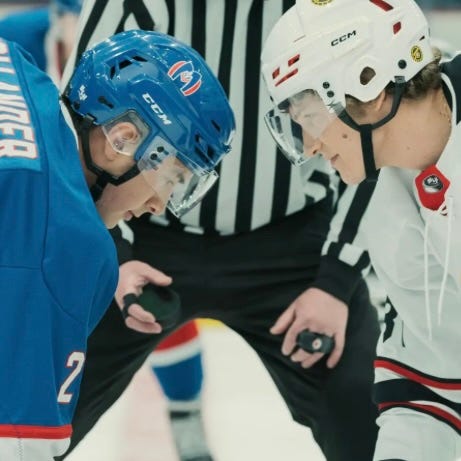
“This fandom is a prison!”
I’ve seen two women online saying that (to be more specific, they were shrieking at the video function of their phones in their cars).
I can relate.
I didn’t expect to fall in love with this relatively low-budget Canadian love story about two major-league ice hockey players.
But … damn. Heated Rivalry gripped me in a way comparable only to the 1995 Pride & Prejudice TV series with Colin Firth as Darcy.
The acting is exquisite (I’ve heard an acting expert opine that Connor Storrie, the Texan actor who plays the Russian player Ilya Rozanov, is a better actor than Timothee Chalamet).
Storrie’s Russian accent is impeccable.
Rozanov is fierce. He is tortured. He is villainous. He is hurt. He is sexually aggressive. He is emotionally cornered.
He is, always, a warrior on the ice.
It’s Ilya Rozanov’s hairstyle, his quotable quotes, his rock-hard butt and his menacing smoulder that have female fans a-twitter (and a-shriek).
But I have the swoons for Shane Hollander, the Canadian poppet, played by Hudson Williams.
Hollander is guileless. He is exquisite. He is emotional. He is stoic. On ice, Hollander is a sports prodigy – fast, focussed, silent.
Over six episodes Hollander and Rozanov try to keep their love a secret – from the public, from the hockey world and from each other.
The show takes place over a decade. To say this is a “slow burn” is to understate the intense emotional yearning that builds between the two.
Things start out rough.


Rozanov and Hollander are rookies. Both are in the closet.
In the first scene of the first episode, the Russian rookie is outside for a smoke. It’s a grimly cold day. The backdrop is a roughed-up pair of warehouse doors. Rozanov’s clothes could be from almost any period – the dark beanie, the inadequate jacket. As he struggles with his lighter, Rozanov looks both frightening and exposed. The vibe is 1980s Soviet Russia.
When the Canadian teenager walks over, he is dressed in a cozy jacket, white hoodie and knitted hat. His cheeks and lips are pink. He’s polite and friendly. His vibe is 1980s teen idol.
I’ve known about the 2024 book Heated Rivalry for a while. It’s by sports romance author Rachel Reid and it’s the second in her Game Changers series.
Reid has written two other hockey romances outside the six-book Game Changers series. As she says, “I like to write cute smut about hockey players”.
Did you know hockey novels were a thing?
GoodReads has a list of the 100 most popular hockey romances. That’s right the hundred best. The top spot belongs to The Deal by Elle Kennedy. It’s been rated by readers on GoodReads more than a million times.
Ice hockey is a tough sport played by men with tough bodies. (One of the funniest things I’ve heard over here is that female ice hockey fans call the rink “the boy aquarium”.)
In ice hockey there are pads and helmets. There’s frequent fighting. It’s fast and dangerous. It’s loud – bodies slamming into barriers, skates whoosing, pucks slamming into the back of goal.
There is much to fear: the blades of the skates, the swinging sticks, the hard, whizzing puck – and mostly, the ice itself.
Hockey players are famously macho. They swear and spit. They drink, they insult each other. Hockey coaches are tough to a fault. The air and the ice are frigid, but blood runs high.
Hockey romances work because gay relationships are effectively forbidden in this environment.
It’s thrilling to read about two macho, ripped hockey players fall in love. They have to be committed to take the risk. Plus, secrecy and frustration make for some hot sex scenes.
Romance in general – the vulnerability, the tenderness – runs counter to ice hockey team culture.
Heated Rivalry was a hit because it was full of hate sex, a classic enemies-to-lovers trope and a long, slow burn.
Heated Rivalry’s early enemies-to-lovers trope is extreme. Ilya and Shane are in conflict emotionally, physically and professionally. They are in major league competition, on opposing teams. The early part of the story features scathing repartee, hate sex and full body slams.


I went to a major league ice hockey game and it freaked me out. The seating was steeply tiered. The chanting sounded like baying for blood. It was like being in an indoor arena for gladiators – like a scene from The Hunger Games.
Pretty early on there was a fight. Helmets and gloves were thrown down by two of the players. The umpires and the other players froze (our American friend told us it’s standard for everyone on the ice to wait while a fight plays out). Hard punches were thrown as the crowd roared – not one, but several. The younger fighter spent the rest of the game off the ice, with team doctors.
There’s another reason that Heated Rivalry works.
It came out in November 2025. The hype around the show peaked to coincide with the start of the 2026 Winter Olympics.
The Olympic final of the mens ice hockey tournament will soon be played. Team USA is in the quarter finals.
When Americans hear ice hockey and Winter Olympics in the same sentence, their hearts beat harder and faster.
The “boys” of the American ice hockey team at the 1980 Winter Olympics captured the nation’s heart with their underdog story.


No-one thought they had a chance against the Russians.
The Russian team was strong, fit, strategic – and highly established. They were older, they were tough. They’d proved themselves to be unbeatable.
In 1980, the Cold War was icy. American politics were not in great shape. Neither was the economy. Soldiers who had made it back from Vietnam had only been home for five years.
The American ‘boys’, coached by Herb Brooks, met the Russians on the ice in Lake Placid, New York. The home crowd expected little. What happened was a sports miracle.
Netflix released its rousing documentary entitled Miracle on Ice last month.
Those who remember the 1980 game have been reminded, and those (like me) who had never heard about it, were gripped.
Heated Rivalry shares some themes with the documentary Miracle on Ice: youthful courage, pioneering the impossible and facing down demons.
The 1980 USA team’s coach, Herb Booth, was at times both physically and verbally abusive.
Ilya’s father is a senior military officer who both drives and shames his son.
Connor’s mother can be pushy and insensitive.
There are other references too. When Ilya, as captain, yells at his team saying they will not lose, it recalls the 1980 Team USA players who rallied, without interruption by their coaches, before the final minutes of play against Finland.


Heated Rivalry – both the book and the show – puzzles some people.
The readers of the book are almost all women. That’s true of all romantic novels in this country.
Romance Writers of America data indicates that approximately 82% of romance readers are female.
Why do women choose to read steamy love stories in which they are not represented?
A common theory is that women enjoy reading about tough guys being vulnerable.
In hockey romances it’s possible to set up a strong contrast between a hyper masculine player and his "soft," vulnerable, and protective side, often referred to as the "cinnamon roll" or "golden retriever" archetype.
My psychotherapist friend over here thinks that women like reading about love and sex between two men because there is no male-female power dynamic. There’s a greater sense of equality from the start.
Another friend tells me that women enjoy watching men have sex, and it’s because women react physically to a wider variety of erotic stimuli than men. Proof of women having this ability to respond more broadly than men is present in studies by researchers like Meredith Chivers.


The makers of the TV show Heated Rivalry had a great deal to work with, including Rachel Reid’s exciting queer romance within a popular genre; the timing of the Winter Olympics; and the release of Miracle on Ice.
What fans seem to most appreciate, though, is the seriousness with which the actors and director approached the project.
Heated Rivalry is pure entertainment – and it’s extremely well made.
So hockey novels are a thing! I wish they’d take off here, then perhaps there’d be more interest from the public in the Winter Olympics and we’d get it on our TV channels! But no — since the deal between Multichoice and the French we can’t have the Winter Olympics because — (cue French accent) — No Africans they don’t watch winter sports. Do they even know what snow is? — Non, les Africains ne regardent pas les sports d'hiver. Savent-ils seulement ce qu'est la neige ?
Really enjoyed a recent Women's Ice Hockey game (a first for me, it was quick and slick, not as rough as the men's it seems) - thanks for alerting us to this series; it is good to explore these 'new' things so foreign to life back home in SA.