
Two Cocks Fighting
Gorgeous room, uncomfortable history

May 2026
There’s a British show I love called Interior Design Masters. I watched Season Six last week. There was a fair bit of “colour drenching” (where you paint not only the walls of a room, but the ceilings too).
On the show, there was also mural painting – a giant Picasso-esque ‘face’; and a ‘collage’ of words raining down a wall. Several people made original artworks for their spaces, and one contestant made fake bamboo and painted it gold for picture frames.
When I walked into the The Peacock Room in Blue and White at the National Museum of Asian Art last week, I was reminded that there’s nothing new in this world.
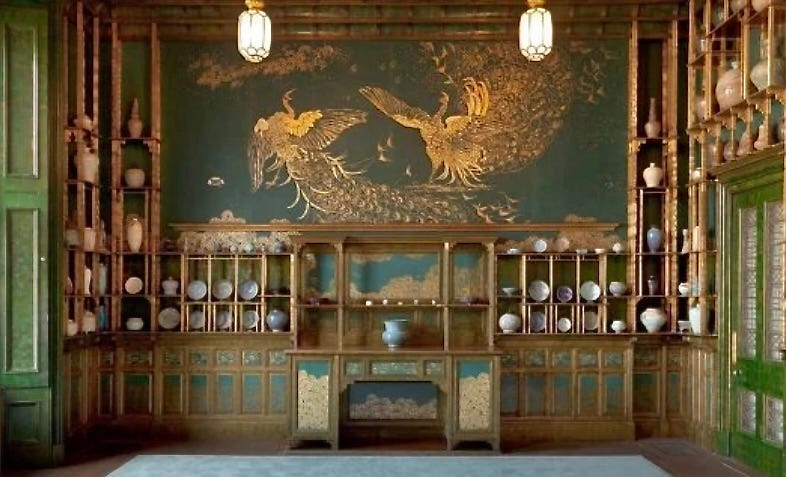
The walls and ceiling are drenched in colour.
The decoration on the walls and ceiling is not wallpaper, it’s handpainted.
Interior Design Masters guest judge Sophie Robinson once remarked that a certain room was a the kind of place she’d take home to meet her parents. In other words, she didn’t want “to snog its face off”.
Sophie Robinson would want to snog the absolute face off the Peacock Room.


The ceiling dips into the lights. It reminds me of trumpet flowers.
The gold-leafed star pattern of the ceiling is echoed in the leaded window.
The shelves and shelf supports are gold – as is some of the wall painting.
The Peacock Room is riotously ornate. What makes it so elegant is the restriction of colour: just jade and gold (more specifically, the blue-green and gold typical to East Asian art).
Before we get stuck into the purpose of the room – or what Sophie Robinson would call '“the client’s brief” – let’s make sure we’ve taken in all the details.
There are long gold panels decorated with undulating peacock tails. There is panelling and a built-in server. Above the server, there’s a mural of ‘feuding fowls’ – or what Sophie Robinson and I would call ‘fighting cocks’.
On the opposite wall, the fireplace. And above the fireplace, a giant oil painting framed in gold. The woman in the painting is dressed in a gown like a kimono, and she is surrounded by what used to be called ‘Oriental’ objects - Chinese and Japanese patterned screens, carpet and textiles.
On every wall, there are large pottery vases, urns, bowls and plates. These are all blue and white.


Now to the ‘client’s brief’. The purpose of this room – and the reason it is called The Peacock Room in Blue and White – was to display a collection of valuable Chinese pottery.
These days we can buy Willow Pattern plates in Target and Checkers. We are unable to comprehend how rare and desirable antique Chinese pottery was to Western collectors in the Victorian era.
Frederick Richards Leyland was such a collector. He was a wealthy shipping magnate, based in London, and was married with children.
Leyland collected Kangxi-period pottery, the blue-and-white porcelain dating from the time of the Chinese Kangxi emperor (reigned 1662–1722). Everything Leyland bought was at least 150 years old, handmade and handpainted.
Leyland was not unique in his love for Chinese artefacts. In the late 1800s in Europe, the fashion for objects from the Far East was so intense it was nicknamed “Chinamania”.
According to the National Museum of Asian Art’s website, “Kangxi porcelain collectors like Leyland amassed collections and displayed them in rooms designed to showcase them most effectively”.
Leyland commissioned architect Thomas Jeckyll to transform the dining room of his Princes Gate, London, mansion into a show space for his blue-and-white platters, vases and urns.
Jeckyll enjoyed merging English and Japanese aesthetic elements in his work. He was a metalworker as well as an architect. Jeckyll set to work on the commission. It was he who designed the three-dimensional ceiling. Jeckyll installed the latticework for the shelves, decorated with Asia-inspired motifs. He imported leather from Spain and made a feature of it along the walls.
Leyland decided to display another of his treasures in the space. Above the hearth, he hung The Princess from the Land of Porcelain, an oil by his good friend, James McNeill Whistler.


The painting features a dark-haired beauty – the model was Christina Spartali, a woman of Greek descent. The objects around her were all part of Leyland’s collection.
Leyland and Whistler shared a love of Asian objects – although Whistler’s preference was for Japanese art.
Whistler was American born. (His Portrait of the Artist’s Mother is considered a modern American masterpiece.) Whistler studied in Paris and settled in London.
Long before Jeckyll started work on Leyland’s dining room, Whistler completed a number of intimate portraits of his patron’s family members, including Leyland’s wife and daughter.
In 1876, Jeckyll fell ill and was unable to complete the dining room.
Leyland asked Whistler to finish the job. He then left on a long business trip.
With Jeckyll gone from the house, Whistler decided to make some changes. In particular, he felt that Jeckyll’s colour choices did his Princess painting no favours.
Whistler took up his brush.
He changed the colour scheme. He painted over the imported leather. He painted the ceiling. He applied gold leaf to the lattice work. He introduced peacock motifs throughout: from the peacocks with their undulating tails painted on gold panels to the feather motifs from ceiling to floor.
In places, the feather motif is subtle - like the eye-level, chrysanthemum-like gold swirls that evoke the peacock feather ‘eyes’ and are believed to have been inspired by Japanese textiles. On the ceiling and around the fireplace, the feather design is simplified: a pattern of overlapping curves like the gills of gleaming, blue-green fish.
The Peacock Room has been described as Whistler’s greatest interior, and an example of “Victorian splendour”.
When Leyland walked into it, he was incensed.


Leyland had not been consulted about the changes. Whistler wanted 2,000 guineas for the work.
In addition, Leyland suspected Whistler of having an affair with his wife.
The artist Dante Gabriel Rossetti informed Leyland that Whistler was planning to elope with Frances.
While Leyland had been away, his wife had sat frequently for Whistler, often at his studio. The painter had escorted her to events. She was reported to have said she might marry Whistler if she were a widow.
“Rumours, gossip and tense letters” characterised Whistler and Leyland’s “professional dispute”.
There is no historical proof of an affair, but one of Leyland’s parting utterances to Whistler is famous. He told him: “If I ever see you even speaking to a member of my family again, I’ll publicly horsewhip you“.
Leyland also criticized the unauthorized work, suggesting Whistler “take them [the paintings] away and sell them to someone else”.
Whistler was never paid the 2,000 guineas. Leyland gave him half the amount.
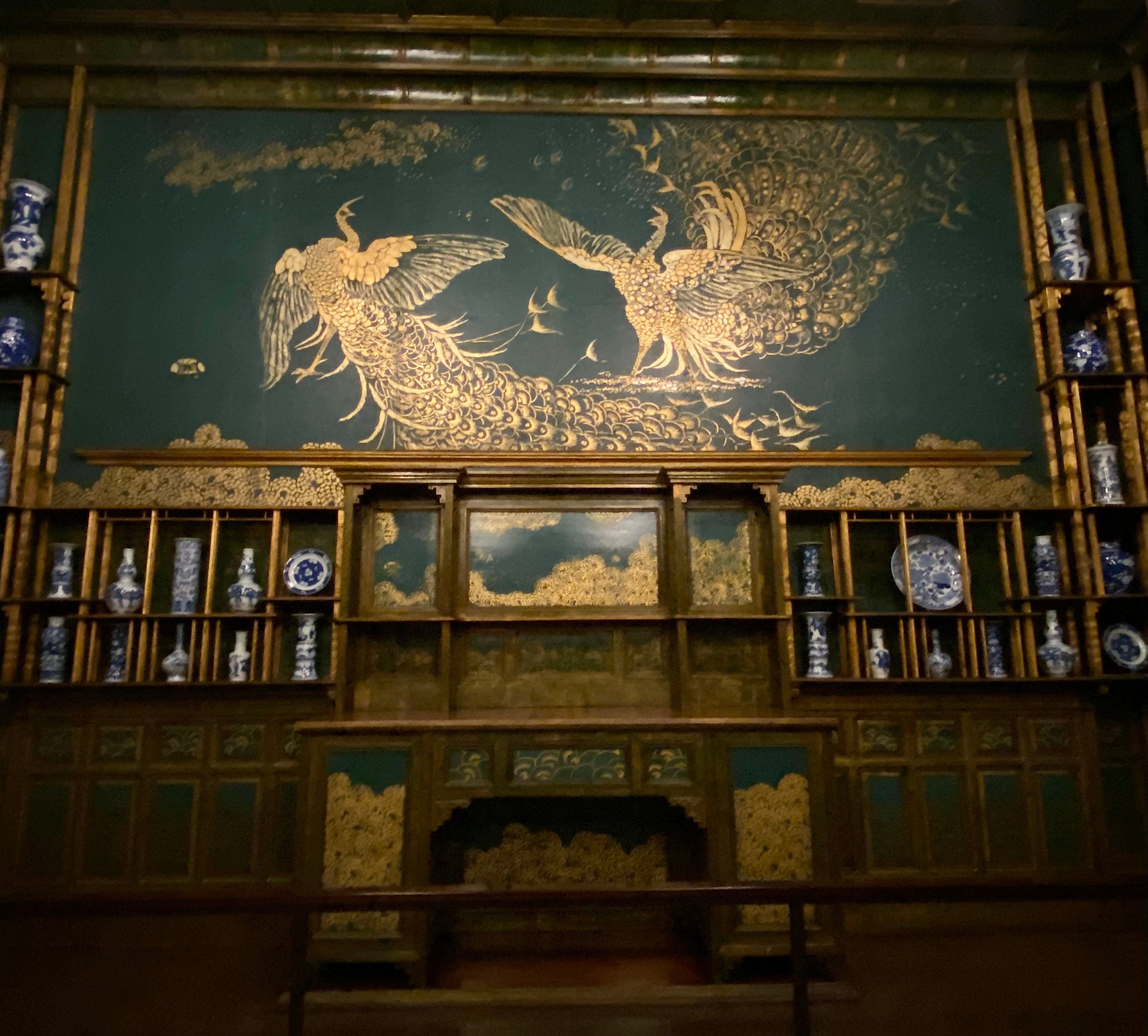
Whistler responded to the reduced payment by painting two angry peacocks on the front wall.
The title of the mural is Art and Money; or, The Story of the Room.
Leyland and Whistler are the fighting cocks – also known as the ‘duelling fowl’. Whistler, the artist, is leaving the frame, tail down. We know it’s him because the peacock has a white streak on its head, just like Whistler’s famous white streak of hair. Next to the defeated peacock, on the left, we see Whistler’s butterfly signature.
Leyland is the triumphant cock, tail and wings up and spread. His chest is revealed: on the curve of his body, his feathers are interspersed with gold and silver coins. His body is so heavy with coins, some have slipped to the ground.
Despite his anger, Leyland never changed the room, recognizing it was a masterpiece. But he never spoke to Whistler again.


In 1892, just 15 years after the debarcle, Leyland died. The Peacock Room was put up for sale in its entirety.
The room was bought by Charles Lang Freer, an American millionaire who made his fortune in rail. In 1904, Freer moved the room – contents and all – across the Atlantic and into his home in Detroit, Michigan.
Freer was an important art collector. He met Whistler in 1890, and effectively replaced Leyland as Whistler’s patron.
Towards the end of his life, in the 1910s, Freer approached the Smithsonian Institution. He said he would donate to the American people entire his collection of Asian art – more than 5000 pieces – as well as a museum in which to house them.
This was the first donation of a private art collection in the United States.
Freer and the Smithsonian’s plans were delayed by World War 1, but in 1923, Freer’s building and the collection within were ready for public viewing.
The Peacock Room was a centrepiece of the building that was named The Freer Gallery of Art and is now part of the Smithsonian National Gallery of Asian Art.
According to Wikipedia, “the legacy of Charles Lang Freer is not just his wealth or art collection, but it is also his generosity as a patron to artists and the public.”
Whistler and Leyland were talented and powerful men, but they were in conflict. Who held the power? The artistic genius or the millionaire? Was it more impressive to be able to create beauty – or to be able to pay for it?
In the end, the answer doesn’t matter. The Peacock Room doesn’t belong to anyone. It is free to view, and visitors are free to make up their own minds about whether or not it was worth it for Whistler to overstep.
Fascinating! And what a movie it would make…
Yo! What a story... and SO well told. Thank you so much xx