
The Hemingways' home
Six-toed cats and two-footed ghosts

December 2026
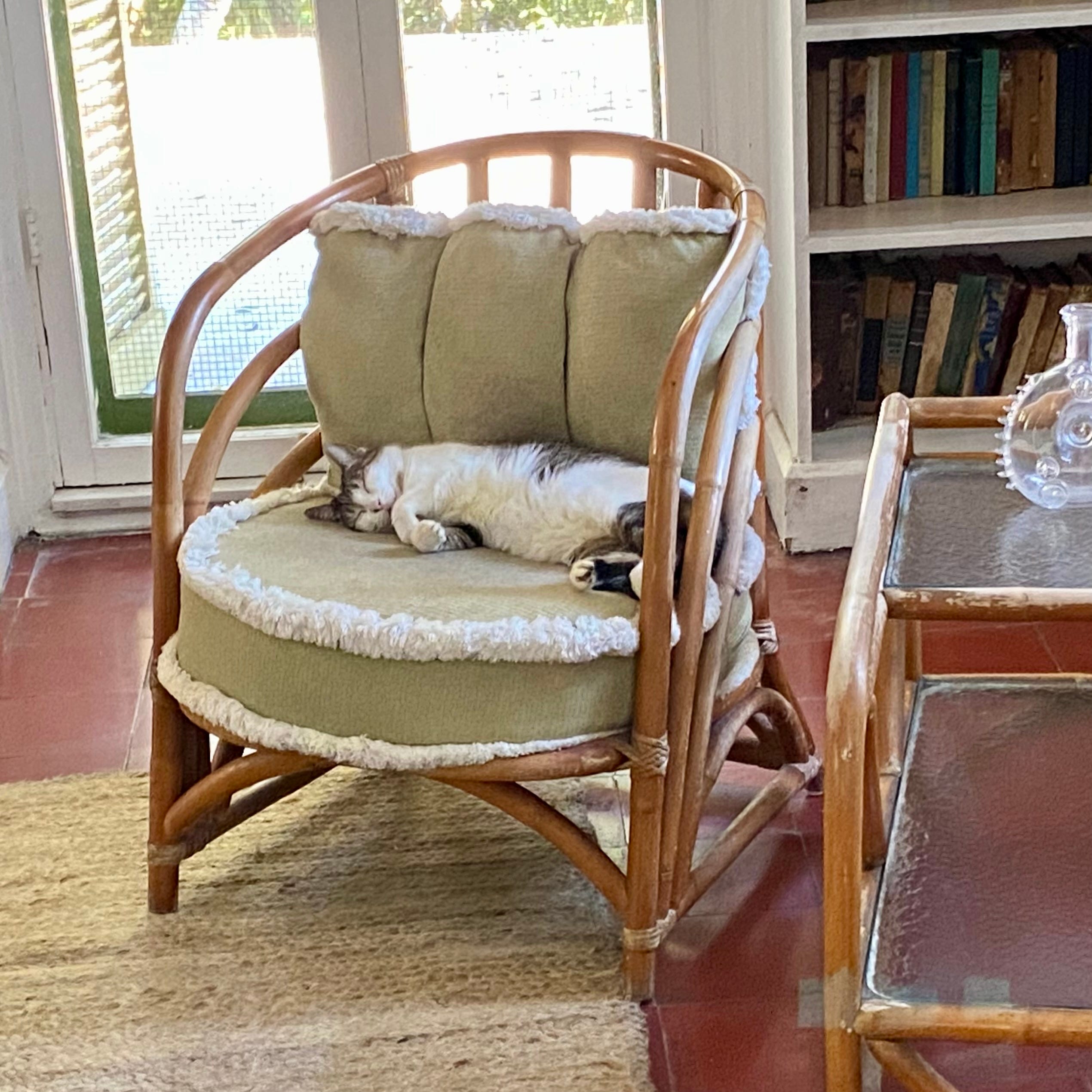
Who doesn’t love a bookshop cat? There’s Cleopatra at Liberty Books in Elgin and the fluffy residential cat at Bibliophile in Clarens.
At the Hemingway Home and Museum in Key West, Florida, there are 61 cats.
It’s a booky, cat-lover’s jackpot.
Not only are there 61 shorthairs on the property – walking off, stiff-tailed, under bushes; or lounging on antique seat cushions; or hiding in the cattery that’s a replica of the Hemingways’ Spanish Colonial home – but about half of them are polydactyl. That means they have six toes on their feet instead of the usual five at the front and four at the back.
“Sometimes it looks as if they are wearing mittens because they appear to have a thumb on their paw,” according to the museum’s website.
Many of the six-toed cats are descendants of Ernest Hemingway’s beloved polydactyl kitty, Snow White.
Hemingway lived in Key West with his wife, Pauline and their two sons, Patrick and Gregory, from 1928 to 1940. Key West is on the Caribbean Sea. The weather is sunny, the sea is warm and giant tropical plants cast deep shadows on the sand. Key West is the southernmost tip of the continental United States and it’s just 90 miles from Cuba.
Hemingway fished from here. He drank at Sloppy Joe’s bar. He and Pauline entertained here. He wrote here, in a study that was connected to his bedroom in the main house by a footbridge (the bridge was subsequently destroyed in a hurricane).
Hemingway took trips from here to Spain during the Civil War and to Africa and other hunting grounds for shooting trips.
I’m not a big fan of Hemingway’s machismo.
I do love his writing. I’ve read The Old Man and the Sea (1952) twice and The Sun Also Rises (1926) made a big impression on me.
But the fishing and shooting? The near-fatal injuries, the war-chasing and skirt-chasing? The drinking and fighting?
Naw.
Also, I’ve been sad about him and Pauline – their marriage, and their boys, and how Pauline died – since visiting the house.
But the kittens in mittens?
It’s nice that Hemingway was a cat man. It’s nice that his sons loved cats too.


Visiting the Hemingway house was more emotional than I’d expected. Pauline, a New York socialite who wrote for Vogue and Vanity Fair, chose the house. It was her Uncle Gus who bought the property as a gift.
Pauline led the “massive restoration and remodeling” of the house that was “in great disrepair”, partly “rubble and ruin”. She was the one who replaced the ceiling fans with Murano glass chandeliers. Pauline had antique doors from a Spanish monastery converted into a headboard for the primary suite. It was Pauline who designed the en suite and had the floor tiled with Art Deco fish and herons. When Hemingway had an affair with Martha Gellhorn in Spain, Pauline proceeded with the plan for a huge and wildly expensive swimming pool.
There’s a sense of conflict in the house – between Pauline’s wealth and taste and Hemingway’s compulsion to seek adventure.
Ernest and Pauline were both elegant and tough in their own ways: Hemingway’s prose is as sparkling, as complex and exquisite, as Pauline’s Venetian glass.
Pauline was tough: she accompanied Hemingway on a hunting trip to Africa in the early 1930s (an attempt to save the marriage after the Gellhorn affair). She safari-ed and shot in khakis, her dark bobbed hair tucked under a man’s hat.
Tough? Pauline was a working New York writer in the early part of the century, when wealthy young women were expected to stay home. Ernest encountered Pauline while she was on a writing assignment in Paris.
The Key West house is associated with Ernest, but Pauline had a greater claim to the property, and lived there longer than her Pulitzer- and Nobel- prize-winning husband. After their divorce in 1940, Pauline stayed on. She died in Whitehead Street in 1951.
As a young mother, there’s no doubt that Pauline channeled her creative energy into the house. It’s what a lot of jobless young mothers do, and Pauline did it exceptionally well. (Green and yellow together? No-one does that. Pauline took a hard-and-fast design rule and broke it like a twig across her knee.)
Did she make the house beautiful to draw her hunting-fishing husband home? I imagine her trying hard to sew their personalities together.
There’s a water feature in the garden near the pool. It’s a huge urn trailing water into a tiled drain.
The drain is the base of a urinal that Hemingway and a pal ripped out of a rental in a drunken rage because the landlord had upped the rent. Hemingway hefted the porcelain block down the street and chucked it into the garden.
He wouldn’t get rid of it, so Pauline fashioned it into the outside water feature, adding the urn and the water, covering the edge of the porcelain with imported, handpainted tiles.
I found that sad. Is it marriage and children that turn big-spirited men base and big-spirited women prim?
When Ernest returned home after his affair with his war correspondent (another unconventional American woman far from home; another writer) he discovered the swimming pool and erupted in anger. He told Pauline she should “take his last penny!” Hemingway flung a coin from his pocket to the ground. She had it set in the still-wet concrete. It was a bitter joke, and one she told to garden party guests: Uncle Gus had paid for the pool.


To me, the cats that live at the house embody everything that Ernest and Pauline, in their marriage, failed to become.
The Hemingway cats are not aggressive, but nor do they people-please. They are unusual – their own special six-toed sub-set – but they are just like any other cat in their independent-mindedness. They will do as they please, when they please.
The most interesting thing about these cats: the open gate. They could leave if they liked. There’s no cage.
Also, no-one lives on the property. These cats are not part of a human family. They are their own pride of 61.
They endure what Hemingway called “gawkers”. They submit to stroking and tickling if it pleases them. When it doesn’t, they don’t confront. They slink away, alone, when they need to. But they manage to stay together, still selfish and still primal, at home.
I’m not sure retreating, staying selfish and staying primal is a good recipe for a happy marriage. Perhaps Ernest and Pauline were more accepting of the other’s solo missions than I imagine. Maybe they were like the cats – but grew apart anyway.
Hemingway was married four times. In the museum there’s a “wall of wives”: photographs of Pauline and her predecessor, Elizabeth “Hadley” Richardson; her successor, Martha; and Hemingway’s final partner, Mary Welsh.
Cats are known to tire of their homes and choose new ones. Cats also hunt. Tom cats fight. Ernest might have related to that.
Cats are elegant, alluring and intelligent. They’re beautiful and they adore comfort. Queens are good mothers. Pauline might have related to that.
Cats are mysterious.
So is writing.
So is love.
Loved this story. Beautiful and sad, as elegant as the cats in it.
Yo! And thank you, as always xx