
New Romance
Hooray for curvy, geeky, queer and middle-aged romantic leads

January 2024
Romance readers love a flavour of impossibility, a pinch of secrecy and a big dollop of pent-up want.
Hollywood film still errs on the side of young, thin, white and straight romantic leads. Books, it seems, are better at diversity.
Why would books want to be diverse? Only because the world is diverse and appealing to the world, as opposed to a fraction of it, leads to higher sales.
Critics don’t review love stories. Universities don’t study them. Book clubs don’t choose them. But people buy them. They buy them in numbers that translate to millions of dollars.
Why? Rule Number One of Romance is that it doesn’t matter who falls in love, a happy ending is guaranteed.
I understand the argument against happily-ever-afters. You don’t need a man to save you. Marriage is not a happily-ever-after in itself. You don’t have to look good in a ballgown to deserve happiness.
That’s true, and romance novels that embrace diversity assert that you don’t have to be straight or a heterosexual woman to want a committed relationship.
Human beings crave connection. Romance novels not only bring together the two romantic leads; along the way the leads usually make new friends, repair broken family bonds and breathe new life into stuck careers.
Romance novels are not about solo quests, the slaying of dragons, vanquishing of enemies and one-man triumphs. Romance novels are about finding a way. They’re about the longing for togetherness, not personal victories.
The difference between the happy ending of a romance novel and other genre fiction works is only this: in a romance the ending is happy because a lasting connection between two people is made; in other genre fiction forms the hero triumphs.
Historically, critics, academics and fellow readers have found the first kind of happy ending icky and the other kind stirring.
People who buy romance novels might have absorbed the message that love stories are low-brow, corny and embarrassing (as opposed to heroic stories that are impressive, important and mighty). But they’re not entirely convinced. Across all communities, they continue to buy love stories in private, and to enjoy them.
I’m with them.
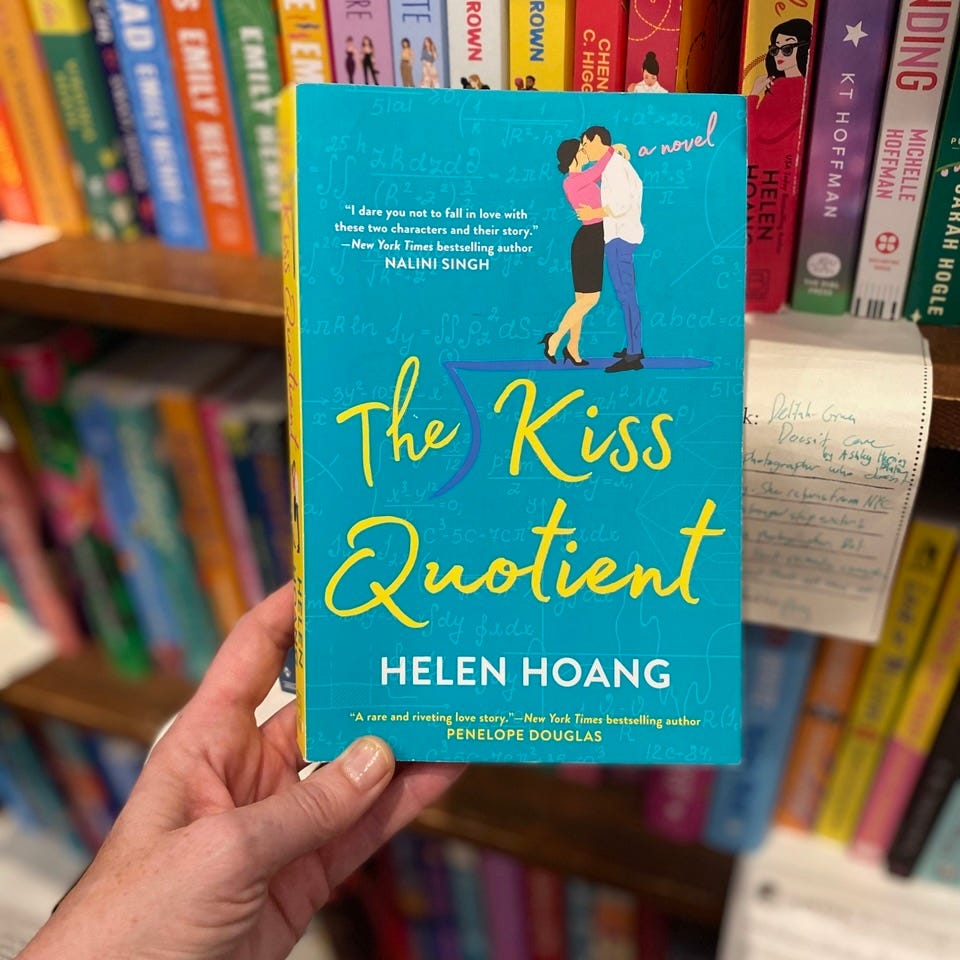
The Kiss Quotient by Helen Hoag
Sex-eee!! This was an unexpected nine on the titillating scale.
Our hero, Michael Phan, is a gorgeous young man with Vietnamese and Swedish ancestory. He does martial arts (Japanese kendo, with swords and armour, if you need to know). A single tattoo snakes around his torso. Michael is an escort.
Stella Lane is a 30-year-old wealthy econometrician who also happens to have Asperger’s.
Stella’s age, autism and sexual inexperience are not the only things that makes her an unusual romantic lead. She’s also a woman in STEM (Science, Technology, Engineering and Maths).
Stella hires Michael to teach her how to have sex. Michael is a good and patient teacher, as we discover in lengthy, minute detail.
The Kiss Quotient is not dissimilar in themes to the movie Good Luck Leo Grande (with Emma Thompson). Both the female leads start off inhibited and end up deeply, eternally grateful when they find someone who unlocks them sexually.
But unlike the Leo Grande movie – and more like the play Pygmalion – The Kiss Quotient becomes a love story too. The sex scenes (unerringly detailed; thank you, Hoag) become increasingly passionate.
Of course there are obstacles. There are secrets. There is pride. There is hurt. There are upsets.
On their journey, the pair advance towards each other and are pushed apart, repeatedly and ever-more seriously. Each make-up sex scene is better than the last.
Throughout the book, the couple grapple with issues related to money, class, race and neurodiversity.
In its final resolution, The Kiss Quotient is so morally wholesome it feels like it could be prescribed as a setwork book for high schoolers. There’s nothing even remotely grubby about it.
Having said that, the sex scenes are genuinely fantastic. You did a clever thing here, Helen Hoag.
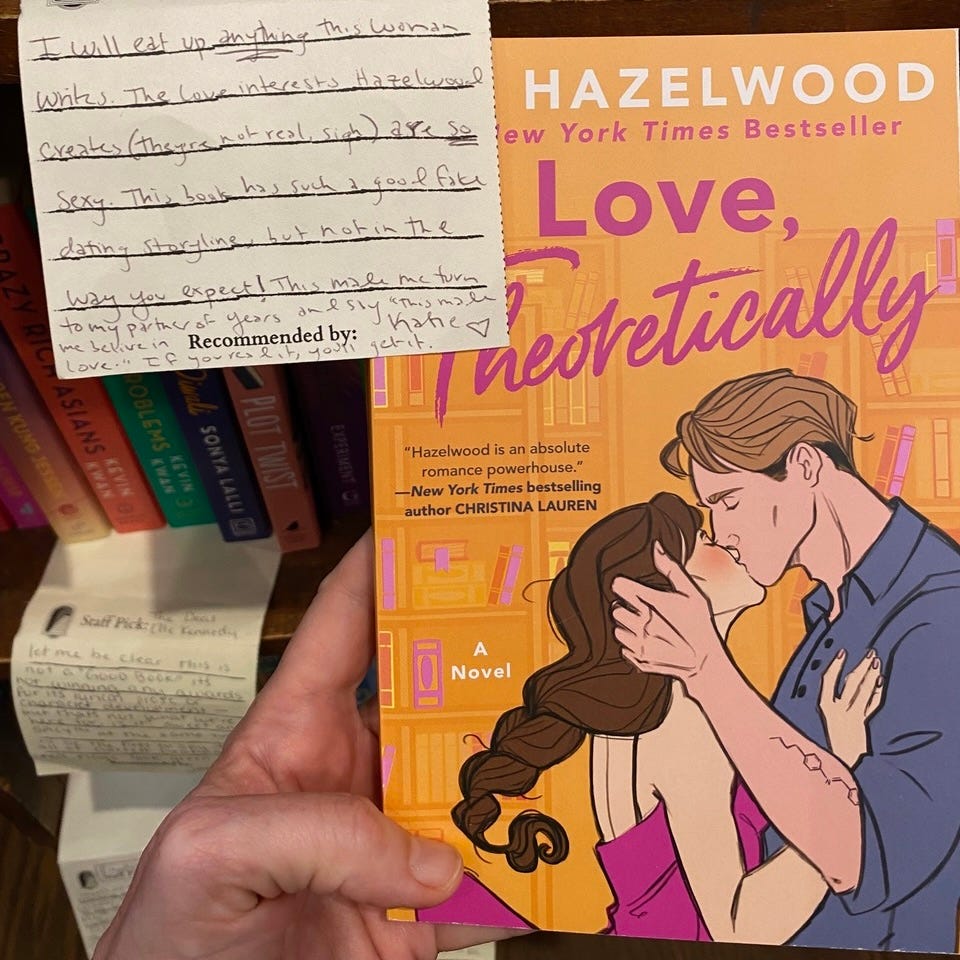
Love, Theoretically by Ali Hazelwood
Okay, Ali Hazelwood, this is awkward but I’m still a bit in love with Jack Smith – and I finished Love, Theoretically a while ago.
Maybe I’m not in love with Jack, but the way he loves Elsie is just EXEMPLARY.
Elsie Hannaway is a theoretical physicist who works as a “fake girlfriend” on the side. Jack is the brother of one of Elsie’s fake boyfriends. He’s also a famous experimental physicist.
Did you know about the teeth-grinding, daggers-drawn emnity between theoretical and experimental physicists? I had no idea!
You won’t believe it, but Elsie and Jack end up working together. There are many reasons for them to hate each other, and to carry on hating each other. So why is their sexual chemistry so hot it could explode the lab?
I don’t know how Hazelwood knows the perfect way for a man to treat a woman – in this case an unusually ethical and talented woman in STEM. Maybe she’s met the perfect man. Whatever the reason, Love, Theoretically could serve as a manual for men everywhere.
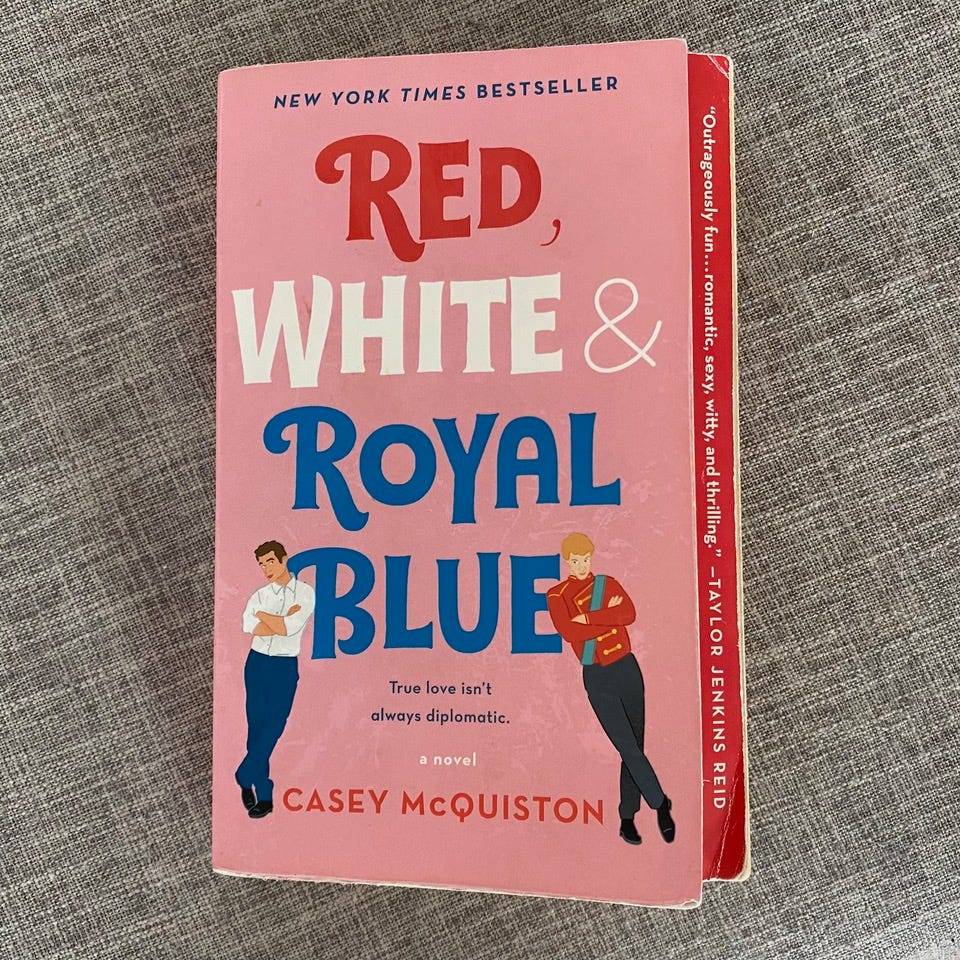
Red, White & Royal Blue by Casey McQuiston
Sound the trumpets, this was fantastic!
Red, White & Royal Blue is the love story of the Queen of England’s gay son and the US president’s bisexual son.
They’ve always disliked each other. Alex Claremont-Diaz finds the prince snooty. When the tabloids get hold of an altercation between the two, the media people on both sides of the pond are horrified. A plan is hatched: stage a truce; a fake, Instagrammable friendship.
By the time Alex flies to London for his photo opps with Prince Henry, Casey McQuiston is already employing three favourite tropes: enemies-to-lovers, fake-relationship and celebrity romance.
Red, White & Royal Blue is jam-packed with so much more. Alex’s best friends are the VP’s daughter and his sister. They have his back but they have their own struggles too. Alex’s parents are divorced. His relationship with his dad is imperfect. His relationship with his mentor takes a turn, too. Alex is idealistic, and a natural politician, but the realities of US politics give him pause.
Add to this the fact that he had no idea he could fall so deeply in love as he has with Henry.
Alex and Henry’s correspondence, their secret meet-ups and snatched conversations convey pent-up passion in the best old-fashioned way.
Henry has similar issues to Alex, but Henry’s time in the spotlight will never end.
Red, White & Royal Blue sold 100 000 copies in its first seven months.
McQuiston has done such a clever thing: she’s updated the Cinderella story so that both Alex and Henry play both roles: both are the handsome prince and both are the trapped, lovestruck outsider.
The sex scenes are terrific; we get a glimpse into bedrooms at the White House and in royal palaces. The secrecy is thrilling; the pomp and glamour is thrilling too.
What really sets Red, White & Royal Blue apart though is the ending. It’s complicated and broad and SO emotional.
I’m not how many men have read Red, White & Royal Blue. I’m not sure how many men read Romance at all. (Also, I can’t think of a male romance author.)
I think they’re missing out. As a weekend read, Red, White & Royal Blue is as smart and big-hearted as they come.
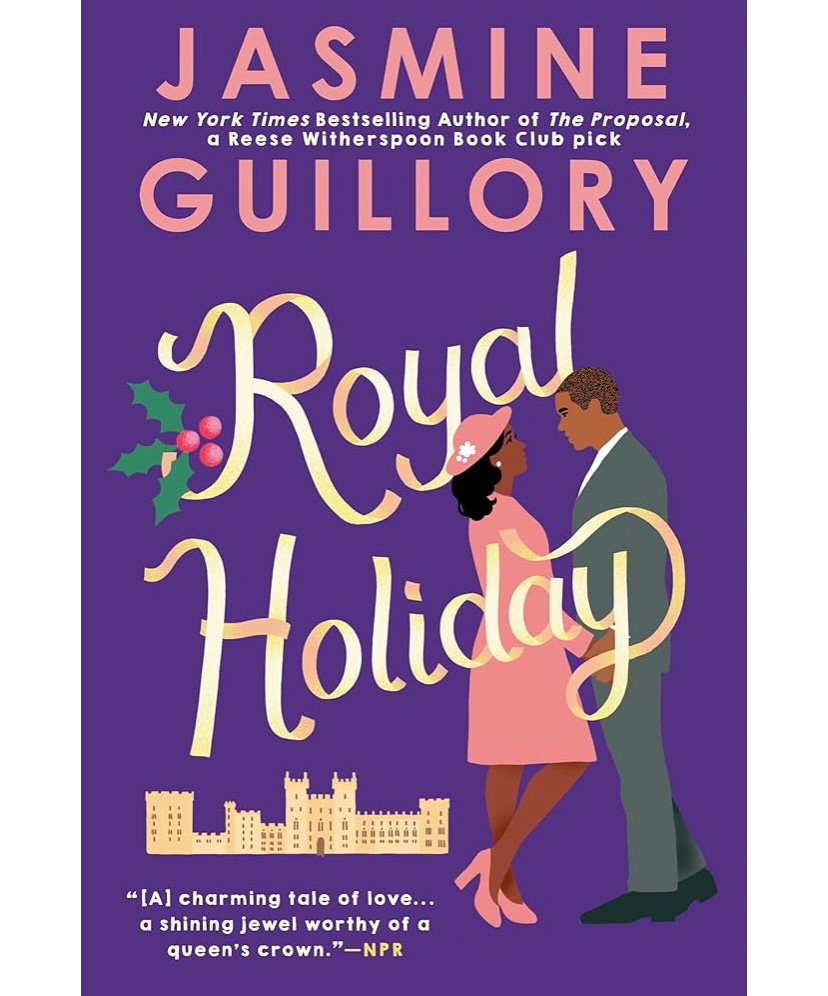
Royal Holiday by Jasmine Guillory
How interesting this was. Royal Holiday is a second-chance love story about middle-aged folks, but it’s written by a young author. This is a story set in the UK, but it was written by an American. Royal Holiday is a feminist take on the Cinderella story.
Wha--?
This last feature of the book seems the most infeasible. How does Guillory bring feminism into this fairytale setting?
Vivian Forest and her daughter are staying with the Duke and Duchess of Wales in Sandringham over Christmas so that Vivian’s daughter can act as the duchess’s stylist.
There are royal gowns for Christmas Eve, twinkly trees, chandeliers, royal steeds, ancient hallways and sealed, hand-delivered messages.
Vivian is, by her own description, “a fifty-something black woman with a grown-up daughter who has never before left the suburbs of California”.
Vivian even meets the Queen – by accident, at her stables.
How do you turn this into a feminist tale?
Ironically, you do it by introducing a love interest.
Malcolm Hudson is the Queen’s handsome, middle-aged Private Secretary.
Vivian is suitably awed by her proximity to the royal family, and the traditions and grandeur of their lifestyle. And yes, she is attracted to Malcolm. But does she long to be chosen for marriage by a handsome prince-adjacent? Does she long for rescue from her humble life? She does not.
Valerie enjoys Malcolm’s attention, and happily anticipates rounds of holiday humping. But her grown-up daughter and her job as a social worker are her priorities, and she needs to be back by New Year.
There’s a surprising amount of conflict in Royal Holiday, mostly resulting from Valerie‘s warts-and-all honesty, her mother-knows-best interventions and her unapologetic self-reliance.
Valerie is a romantic lead who seems plucked from the supporting cast. She is neither svelte, nor young. She is not starry-eyed nor prone to fainting spells. Stout, sure-footed Valerie seems to need nothing and no-one.
But what if, Guillory seems to ask … what if the Fairy Godmother swished her wand over the wrong person? What if the wand touched somebody who had played an uncomplaining support role in the lives of her daughter and in-need strangers for all her adult life? What would Valerie‘s wish be, and how could someone else make it come true?
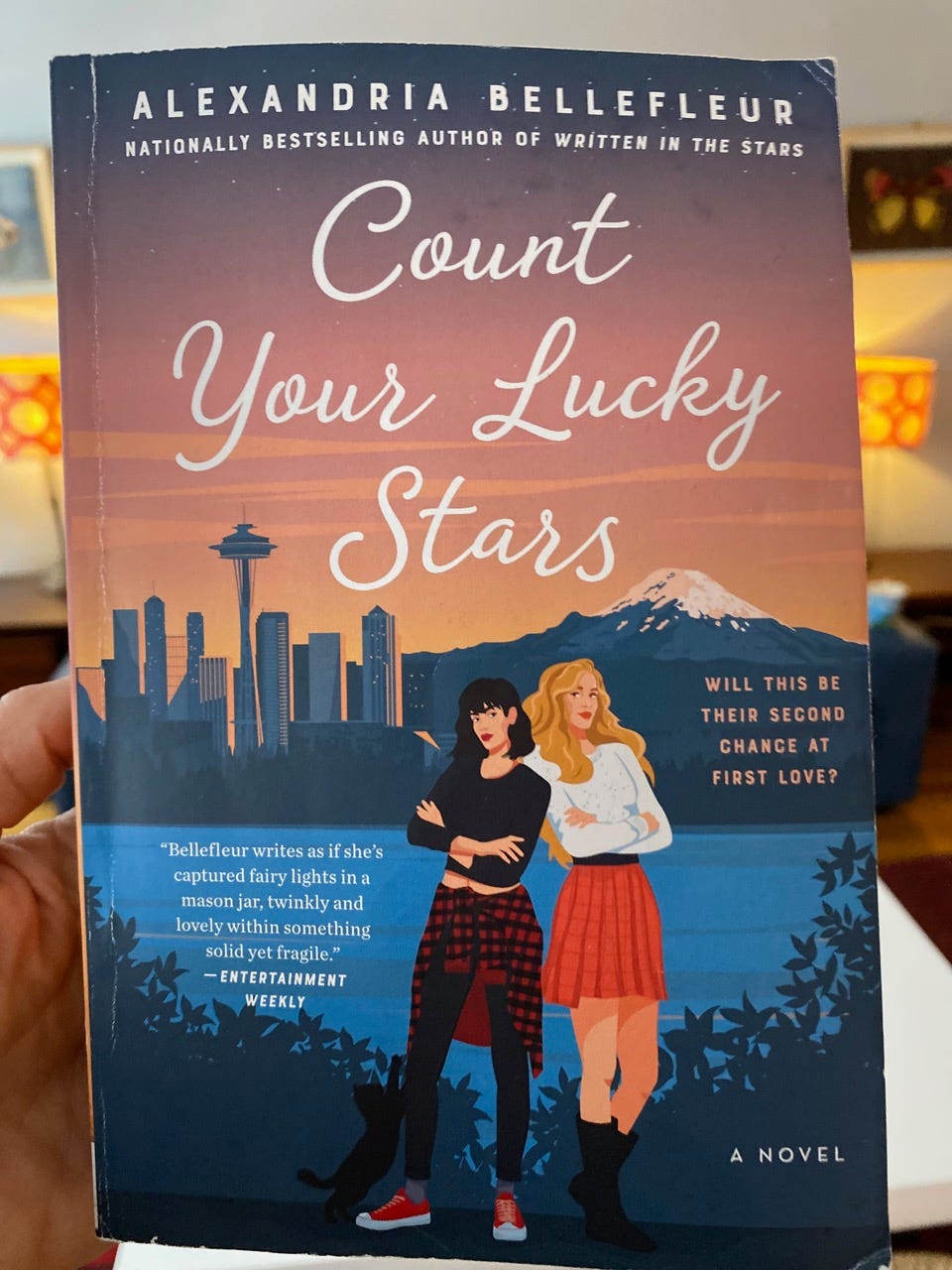
Count Your Lucky Stars by Alexandria Bellefleur
Here’s the second-chance-at-first-love trope. It’s a powerful one. The author offers to two adults the unguarded passion and lusty, experimental sex that characterised their first love.
But conflict is inherent. Maybe the reasons they broke up the first time still hold? Maybe the hurt from that breakup is too much for one or both of them to overcome. Maybe their lives are too different now to accommodate each other?
Margot and Olivia face all these problems – and many more! There’s a professional conflict; there are misunderstandings; there’s jealousy and pride. But woo-hoo, the passion hasn’t died. Margot and Olivia’s hearts and bodies want each other bad.
I enjoyed this. Bellefleur has won literary awards for her writing. Her romances have been described as “swoony”. That’s a good word.
Bellefleur is known for her grumpy-and-sunshine couples. In this case, Margot is the loveable grump; Olivia has the sunny personality.
Count Your Lucky Stars is the second in Bellefleur’s three-book Written In The Stars series.